How a Short Torso Changes Which Coat Length Actually Works
Quick Answer: With a short torso, the coat lengths that cause trouble are the ones ending near the natural waist or at mid-hip, because both draw the eye to the shortest section of your frame. The lengths that generally work are cropped above the waist, or long enough to clear the hip entirely and create one unbroken vertical line. Height is not the variable - two people of the same height with different torso lengths need different coats.
You tried on four coats in the same size and one of them looked completely different on you.
That was not the fit. That was where the hem landed relative to your waist.

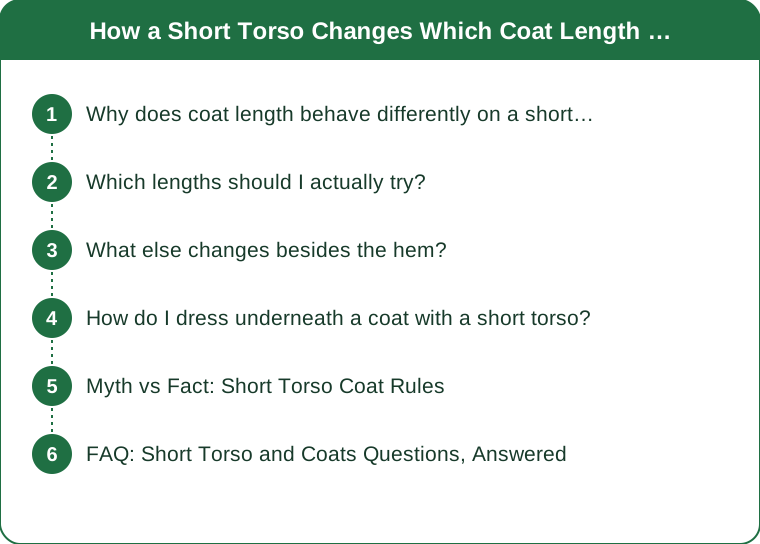
Why does coat length behave differently on a short torso?
Because a coat hem is a horizontal line, and horizontal lines mark where the eye stops.
With a short torso, the space between bust and waist is compressed, so a hem landing anywhere in that zone divides an already short section.
A hem at the natural waist emphasises exactly the measurement you would rather not emphasise, which is why belted coats can be tricky unless the belt sits low.
A hem at mid-hip creates a second short block immediately below the first, producing a stacked look.
Whereas a hem above the waist reads as intentional cropping and lets the leg line start high.
And a hem well below the hip creates one long vertical, which is why long coats often look better on short-torso frames than the mid-lengths people default to.
Which lengths should I actually try?
Cropped, ending at or above the natural waist. Bomber and cropped wool styles work here, and the key is that the hem is clearly above the waist rather than at it.
Long, ending at mid-calf or below. The unbroken line is doing the work, and the coat reads as a full-length column.
Knee length can work if the coat is unbelted and has a clean straight cut - the length is far enough below the hip to avoid the stacking effect.
Approach with caution: hip length, mid-thigh with a belt, and anything ending exactly at the widest part of your hip.
Try the same coat in two lengths if the brand offers it, which is the fastest way to see the effect on your own frame.
And judge in a full-length mirror from six feet back, because proportion problems are invisible up close and obvious at distance.
What else changes besides the hem?
Where the buttons sit. A high first button shortens the visible torso further; a lower button stance opens up vertical space.
Lapel length. Long lapels create a vertical line down the chest and are consistently helpful. Short round lapels do the opposite.
Pocket placement. Patch pockets high on the body are a horizontal marker in the worst possible place - low welt pockets are safer.
Belt height, when there is one. A belt worn slightly below the natural waist lengthens the torso visibly. Many coat belts are positioned for average torso length and can be moved down by an inch or simply tied lower.
Collar volume. A very large collar compresses the neck-to-waist space and can make a short torso look shorter.
And sleeve length, which is not a torso issue but is the alteration most worth paying for, because a coat that fits everywhere else is worth adjusting.

How do I dress underneath a coat with a short torso?
Keep the layer underneath aligned with the coat’s logic. A long cardigan under a long coat maintains the vertical; a cropped jumper under a cropped coat does the same.
What creates problems is mixed messaging - a long jumper under a cropped coat produces three horizontal lines within eight inches.
High-rise bottoms are the reliable partner, because they raise the visual waist and lengthen the leg line, which compensates for the compressed torso.
A half-tuck at the front of a top under an open coat does more than most styling tricks, because it establishes a waist point without adding bulk.
Scarves should hang long rather than being bunched at the neck, for the same vertical reason.
And in early autumn, when the coat is worn open more often than closed, the open-coat silhouette is the one to judge in the mirror - two vertical panels framing the body, which is generally flattering and is why open-coat weather is easy weather.
Myth vs Fact: Short Torso Coat Rules
Myth: short people should wear short coats. Fact: torso length and overall height are separate. Plenty of tall people have short torsos and plenty of short people have long ones. The hem should relate to your waist, not your height.
Myth: long coats overwhelm smaller frames. Fact: a well-fitted long coat is one of the most lengthening things available. Overwhelm comes from excess volume and dropped shoulders, not from length.
Myth: belting always defines the waist favourably. Fact: belting at a standard coat-belt height often sits at or above a short torso’s natural waist, which shortens rather than defines. Lower the belt or skip it.
Myth: you can judge proportion in a fitting room mirror. Fact: most fitting room mirrors are too close and often tilted. Step back to a full-length mirror at distance, or take a photo - the photo is unflattering and honest.
Myth: alterations are only for suits. Fact: shortening a coat hem and sleeves is routine tailoring and is what converts a nearly-right coat into the right one. It is often the difference between the good coat and the perfect one.
Myth: your torso length is obvious to other people. Fact: it is not, and it is not a flaw. This is about which of several equally good coats happens to look best on your particular frame.
FAQ: Short Torso and Coats Questions, Answered
How do I know if I have a short torso?
A rough check: measure from the base of your neck to your natural waist and from your waist to the floor. If the upper figure is proportionally small relative to your height compared to standard sizing assumptions, you likely have a shorter torso. The more practical test is whether waist seams on dresses consistently sit too low on you.
What coat length is safest if I can only buy one?
A straight, unbelted knee-length or longer coat with a low button stance and long lapels. It works across the widest range of outfits.
Can I still wear a trench coat?
Yes - tie the belt lower than the loops suggest, or remove the belt and wear it open. Trenches have long lapels and long lines, both of which help.
Should I have my coat hem shortened?
Only for cropped styles, where an inch or two matters a lot. For long coats, altering the hem changes the coat’s balance and is rarely worth it - focus on sleeves instead.
Does this apply to puffer jackets?
More than to any other category, because puffers add volume as well as a hem line. Cropped or long, and avoid mid-hip puffers with horizontal quilting exactly at the waist.
What about wearing coats open?
It helps almost universally, because the open panels create two long vertical lines. This is why so many short-torso outfits look better in September than in January.
TL;DR:
- The coat hem is a horizontal line, and where it lands relative to your waist decides everything.
- Cropped above the waist or long past the hip both work; natural-waist and mid-hip hems are the difficult ones.
- Long lapels, low button stance and low pockets all lengthen the visible torso.
- Wear the belt lower than the loops suggest, or skip it.
- High-rise bottoms underneath compensate for a compressed torso.
- Judge from six feet back or in a photo - proportion is invisible up close.
Coat length is a waist question, not a height question.
Keep Reading
This article is for general informational and styling purposes only. Fit, sizing, and product availability may vary.
