Why Hair Length Changes Torso Proportion More Than Most Clothes Do
Quick Answer: Hair that ends between the collarbone and the mid-chest visually shortens a short torso, because it lands in the same zone your eye uses to judge where the torso begins. Hair that stops at or above the jaw, or well below the bust, moves the boundary out of that zone and lengthens the read. The effect is large because hair is a continuous vertical line adjacent to your face, and it is present in every single outfit you wear.
This is one of the few proportion levers that applies to your entire wardrobe at once.
And it is almost never discussed alongside belts, hems and necklines, which do considerably less.
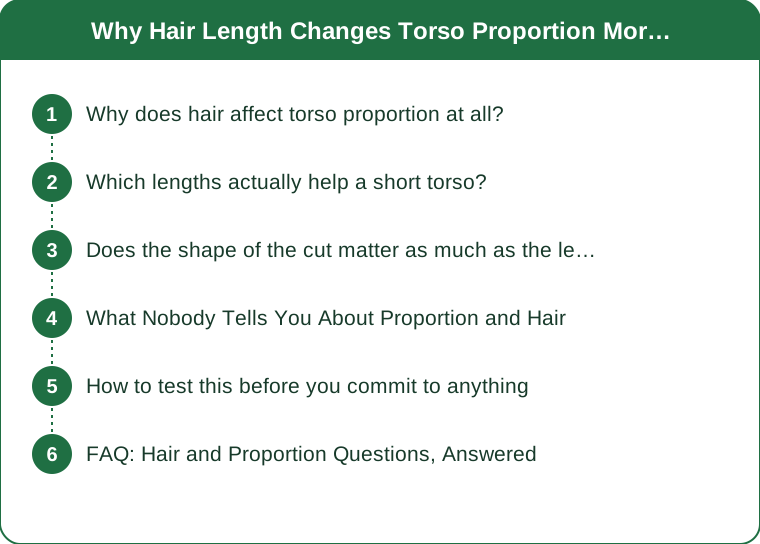
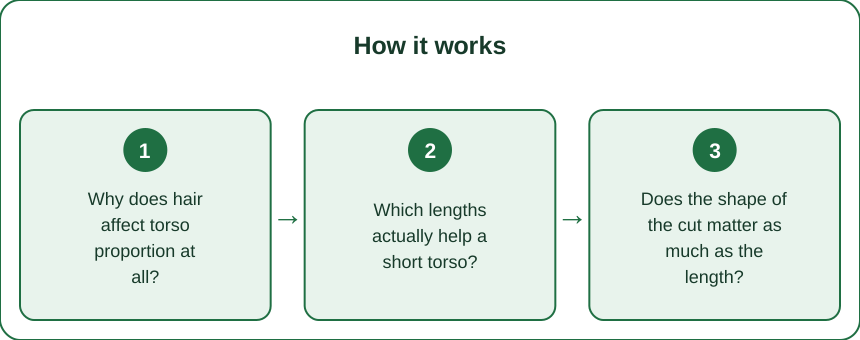
Why does hair affect torso proportion at all?
Because your eye reads the torso as a region between two boundaries, and hair sits directly on top of the upper one.
When someone looks at you, they do not measure your torso. They infer it from where the visual mass of your head and shoulders ends and where your waist appears to be. That upper boundary is genuinely ambiguous — it is not a hard line on the body, it is wherever the visible edge lands.
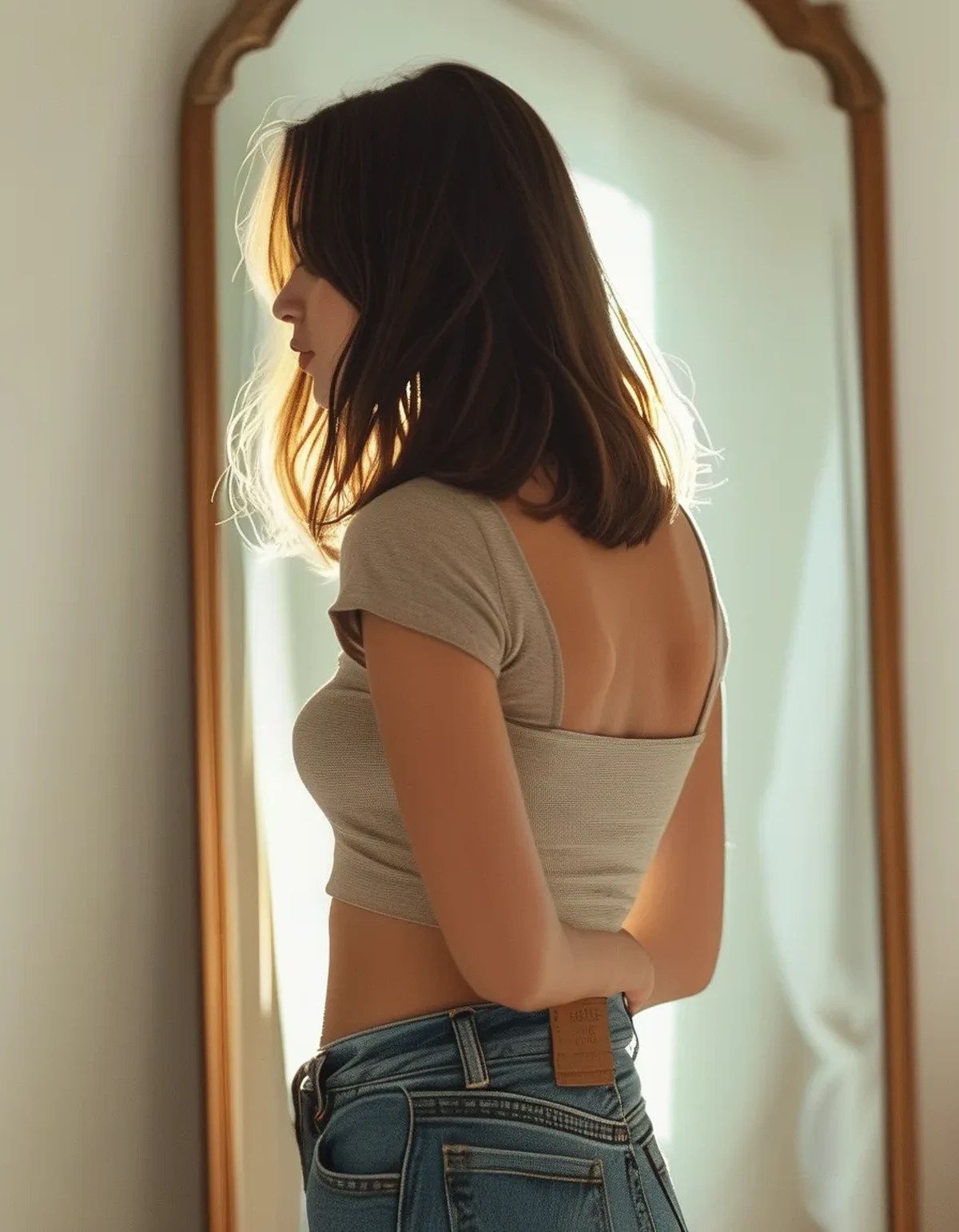
Hair is the largest movable object in that zone. Shoulder-length hair drapes across the upper chest and effectively extends the head-and-neck mass downward, which pushes the perceived start of the torso lower. A lower start means a shorter apparent torso.
This matters much more for a short torso than a long one, because a short torso has less distance to lose. Taking two inches off the top of a long torso is unnoticeable. Taking the same off a short one is the difference between balanced and compressed.
The effect also outweighs most garment interventions for a simple reason: it is there in every photograph, every outfit and every season, whereas a jacket length only applies when you are wearing that jacket.
Which lengths actually help a short torso?
Two zones, and they are on opposite ends.
At or above the jaw. A bob, a lob that sits above the collarbone, or anything shorter keeps the entire hair mass above the torso region. The neck stays visible, the shoulder line reads clearly, and the torso appears to start high. This is the most reliable option and the most commonly recommended.
Well below the bust. Long hair that passes the widest part of the chest stops functioning as a boundary marker and starts functioning as a vertical line running past the torso. Long vertical elements lengthen; the hair reads as flanking the torso rather than capping it.
The problem zone is between. Collarbone to mid-chest — which is, unhelpfully, the single most popular length range — lands the hair exactly where the eye is looking for the top boundary. It is the shoulder-length cut that so many people report makes them look shorter-waisted without being able to say why.
One caveat that matters: volume changes the answer. Very thick hair at a long length can read as mass rather than line, which reintroduces the shortening effect. Long and relatively narrow lengthens; long and very wide does not. If your hair is dense, the shorter zone is usually the safer bet.
Does the shape of the cut matter as much as the length?
Nearly as much, and in a way that gives you options if you do not want to change length.
The operative variable is where the widest point of the hair sits.
Hair that is widest at the jaw or above creates a horizontal emphasis high up, which is fine — it is above the torso entirely. Hair that is widest at the chest creates a horizontal emphasis right at the top of the torso, which reads as a shortening line in exactly the same way a wide collar or a horizontal stripe does.
So two people with identical length hair can read very differently:
Layered with the volume kept high — widest near the cheekbone, tapering downward — lengthens.
Blunt with the weight held at the ends — widest at the very bottom, sitting on the chest — shortens.
This is why a layered version of a collarbone cut frequently works when the blunt version does not, and it is a considerably easier conversation to have with a stylist than a length change.
Parting matters too, though less. A centre part creates two vertical lines framing the face and lengthens slightly. A deep side part creates a diagonal, which is generally neutral to slightly lengthening. A straight-across fringe adds a strong horizontal high up, which is above the torso and therefore mostly harmless for this purpose.
What Nobody Tells You About Proportion and Hair
Ponytails and updos are a free trial. Before you cut anything, wear your hair up for three days and look at photographs. Up is the maximum-lengthening version of your current hair. If your proportions look noticeably better up, length is a genuine lever for you. If they look identical, it is not, and you can stop thinking about it.
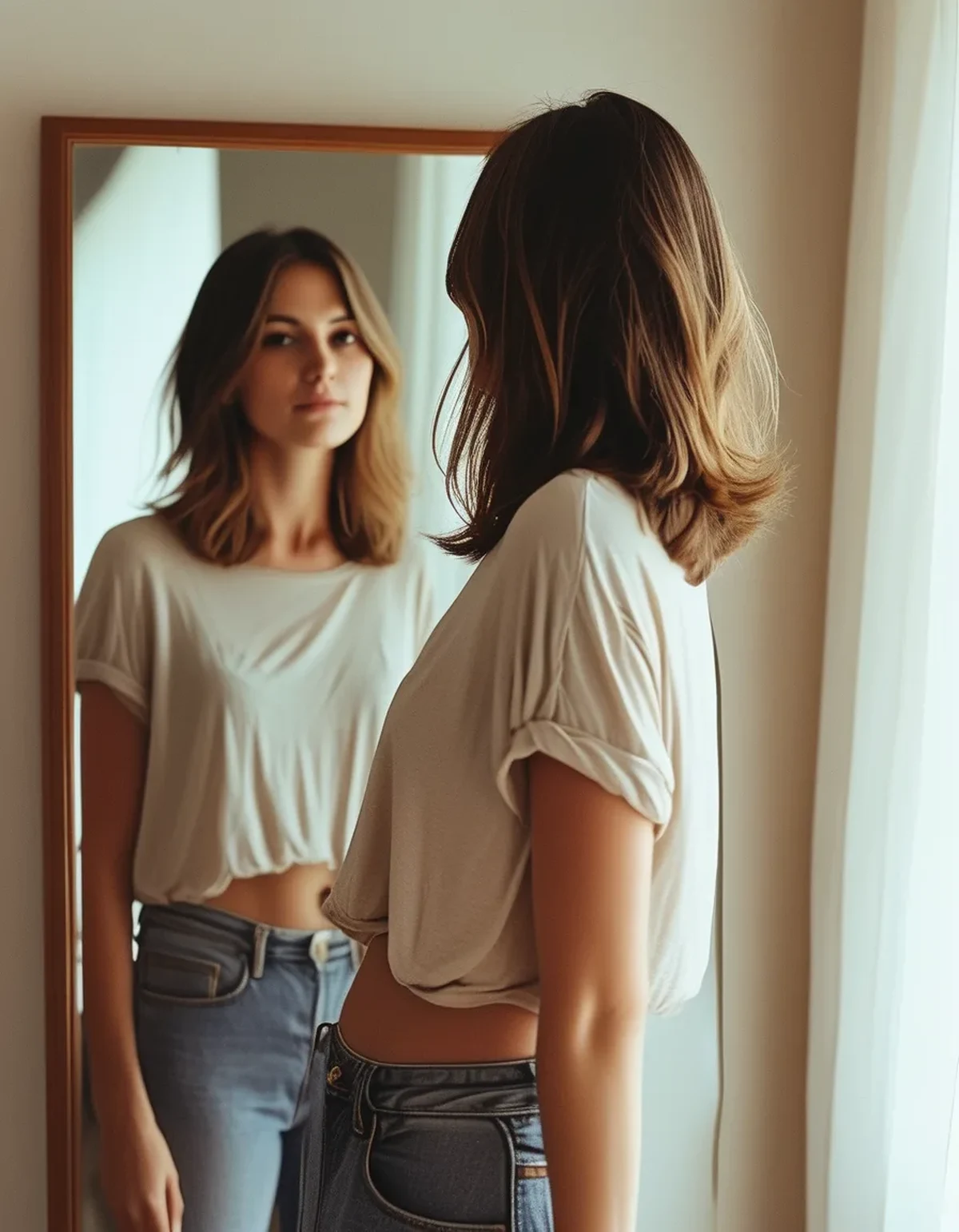
The effect is much stronger in photographs than in mirrors. Mirrors are close, moving and viewed from your own eye level. Photographs flatten everything into the two-dimensional read that other people mostly experience. Judge this from photos, always.
Colour contributes. A hair colour close to your top’s colour blurs the boundary and merges hair and torso into one mass, which shortens. High contrast between hair and top defines the boundary sharply, which usually helps. This is a free adjustment — just change the top.
Autumn quietly changes the equation. Once collars, scarves and jacket lapels arrive, they compete with hair in exactly the same zone. A length that worked all summer over a plain vest can read very differently over a roll neck, which is why proportion complaints spike in the first cold weeks.
Everyone in the photographs you are comparing yourself to is styled for this already. Editorial and brand imagery routinely uses hair placed behind the shoulders for precisely this reason. You are not failing to achieve a natural look — you are comparing yourself to a deliberate one, and the deliberate part is usually just hair tucked behind a shoulder.
How to test this before you commit to anything
Four steps, no scissors involved, done in about ten minutes.
Step 1 — take three photographs in the same top, same light, same distance, from mid-thigh up. One with hair down, one with hair tucked entirely behind your shoulders, one up in a high ponytail or bun.
Step 2 — compare them side by side on a phone screen, small. Shrinking the image removes detail and shows you the proportional read, which is what other people register in the first second.
Step 3 — note where your eye lands first in each. If it lands at chest level in the hair-down shot and at your face in the hair-up one, you have your answer.
Step 4 — try the intermediate options. Half-up, one side tucked, hair swept to one shoulder. These are everyday adjustments that get you a real portion of the benefit with no commitment at all.
If the test says length would help, take the photographs with you to a stylist and talk about where the weight sits rather than about inches. “I want the widest point above my collarbone” is a far more actionable brief than a number, and it leaves the stylist room to achieve it with layers rather than length if that suits your hair better.
And if the test says it makes no difference, that is genuinely useful information too — it means your proportional lever is elsewhere, most likely in waistband height and top hem length, and you can stop spending attention here.
FAQ: Hair and Proportion Questions, Answered
Does this apply if I am tall?
The mechanism is the same, but the stakes are lower. Overall height gives you more total vertical distance, so a couple of inches of apparent torso matters proportionally less. Short torso plus shorter overall height is where the effect is most visible.
What about a fringe?
Fringes work mostly above the torso zone and are therefore fairly neutral for this purpose. A long curtain fringe that sweeps down towards the collarbone is the exception, since it extends the vertical mass downwards.
Is there anything I can do without changing my hair at all?
Yes — tuck one side behind your shoulder, raise the contrast between your hair colour and your top, and keep necklines open rather than high. The one-side tuck alone gets you a surprising share of the effect and takes two seconds.
Does hair texture change the recommendation?
Curly and coily hair adds volume that generally sits wider, so the widest-point rule matters more than the length rule. Placing volume high and keeping the chest area narrower is the same principle, achieved differently.
Should I be styling around proportion at all?
Only to the extent that you enjoy it. This is a tool for when you look at a photograph and cannot work out why an outfit is not landing — not a rule anyone is obliged to follow. Plenty of people look best in exactly the length that theoretically shortens them, and looking like yourself outranks every proportional principle here.
TL;DR:
- Your eye infers where the torso starts, and hair is the largest movable object in that zone
- Collarbone to mid-chest is the shortening range; jaw-length-or-above and well-below-the-bust both lengthen
- Where the widest point of the cut sits matters nearly as much as the length itself
- Test it with three photographs — hair down, tucked back, and up — viewed small on a phone
- Contrast between hair colour and top colour is a free adjustment that sharpens the boundary
Before your next haircut, wear your hair up for three days and photograph one outfit each day. Ten minutes of evidence beats a season of guessing at belt placement.
Keep Reading
This article is for general informational and styling purposes only. Fit, sizing, and product availability may vary.
