Why Oversized Knitwear Shortens a Short Torso — and What Fixes It
Quick Answer: Oversized knitwear shortens a short torso because it covers the waist, removing the only reference point that tells the eye where your torso ends and your legs begin. Fix it three ways: a front tuck to re-establish the waistline, a hem that clearly clears the hip rather than sitting on it, and a vertical line down the centre — an open layer, a long necklace, or a front placket.
Every autumn the same thing happens. You buy the big cosy sweater, put it on, and something is wrong.
It is not that it looks bad exactly. It is that you look shorter, and your legs look shorter, and you cannot work out why since the sweater is not even long.
The mechanism is specific, and once you know it the fix takes about five seconds.
Why does covering the waist matter so much?
Because the waist is the only free information the eye has about proportion.
Your visual system judges leg length as a ratio — the distance from the waist to the floor, relative to total height. It cannot measure your actual leg bones; it uses whatever visible boundary suggests where the torso ends.
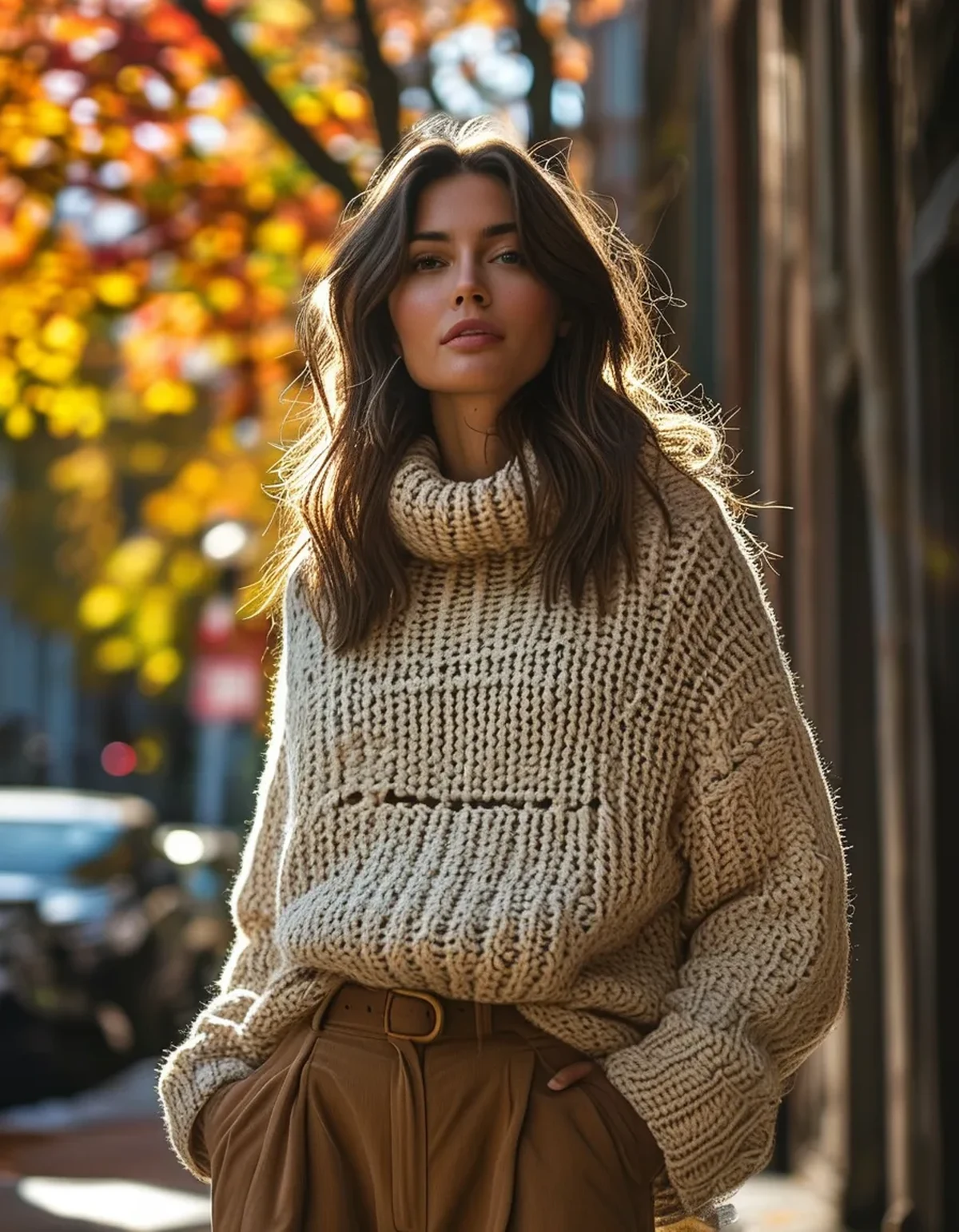
Cover the waist and the eye defaults to the sweater hem as the boundary. If that hem sits at the widest part of the hip, your apparent torso just got several inches longer and your apparent legs got several inches shorter.
For a short torso this is worse than for a long one, because you have less torso to lose. The proportional change is larger relative to the starting point.
This is also why the same sweater looks great on some people and odd on you. It is not the sweater; it is where its hem lands relative to your specific waist position.
Does the front tuck really do that much?
It does, and it is the highest-return five seconds in autumn dressing.
A front tuck — pushing just the front centre of the hem into the waistband and leaving the sides and back loose — re-establishes a visible waistline while keeping the oversized volume everywhere else.
You get the cosy silhouette and the proportional information at the same time, which is exactly the combination you wanted.
Technique matters more than people think. Tuck a small amount, only the centre front, and pull a little back out so it blouses slightly. A tight full tuck removes the volume that made the sweater appealing; a half-hearted one falls back out within an hour.
It works best over a high-rise bottom, because a high waistband gives the tuck a defined line to sit at. Over a mid-rise, the tuck lands somewhere ambiguous and does less.
Where should the hem actually sit?
Anywhere except on the widest part of your hip.
Two safe zones: clearly above the hip, at or just below the natural waist, or clearly below it, at mid-thigh or lower. Both read as deliberate.
The failure zone is the hip itself. A hem there draws a horizontal line at your widest point and puts the eye’s torso-ends-here marker at its lowest possible position.
For a short torso, above the hip is the stronger of the two options — it maximises visible leg length and it is what makes cropped knitwear so reliable on a short torso even though the general advice about cropped tops is mixed.
If you already own the sweater and its hem is wrong, the front tuck effectively moves the hem up, which is a large part of why it works so well.

What else re-lengthens the line?
Three things, and they stack with the tuck.
A vertical centre line. An open cardigan or coat worn unbuttoned creates two long vertical lines down the front and breaks the horizontal mass of the sweater. This is why an open layer over a big knit looks better than the big knit alone.
A long necklace over the sweater does the same job on a smaller scale, and it is the cheapest version of it.
Continuity below the hem. If the sweater ends at the hip and the trousers are a strongly contrasting colour, the horizontal break is emphasised. Tonal or matching colours below the hem soften it substantially.
And footwear that continues the leg line. A boot in a colour close to your trousers extends the visible leg; a contrasting ankle boot cuts it short — which on a short torso undoes some of what the tuck just achieved.
5 Mistakes That Shorten a Short Torso in Autumn
A belt over the sweater at the wrong height. Belting an oversized knit can work, but placed at the hip it emphasises exactly the boundary you want to move. It must sit at the natural waist, which on a short torso is higher than most people place it.
A scarf that ends at the hip. Long scarf tails create a vertical line, which is good, but tails ending at the hip put another marker at the failure zone. Either much longer or tucked shorter.
Layering two hems at similar heights. A shirt hem at the hip and a sweater hem two inches below creates a doubled horizontal band. Offset them by at least 10cm or hide one entirely.
A cropped jacket over a longer sweater. This puts a strong horizontal line mid-torso on a torso that is already short. The reverse — long over short — works far better.
Buying the size up for the oversized look. Sizing up increases the length as well as the width, which drops the hem into or past the failure zone. Buy your size in a style cut oversized, rather than a bigger size of a regular cut.
FAQ: Short Torso Styling Questions, Answered
How do I know if I actually have a short torso?
Compare the distance from shoulder to natural waist against waist to floor. If the lower measurement is proportionally large relative to your height, you have a short torso and long legs — which is a good thing to dress for, not a problem to fix. The practical sign is that high-rise trousers feel like they reach your ribs and tops always seem long.
Do I have to avoid oversized entirely?
Not at all. Oversized works well on a short torso with a defined waist point — front tuck, higher hem, or an open layer. What does not work is oversized with no waist information at all, which is the default way it is worn.
What about oversized coats?
Those are fine, and often flattering. An open coat creates the vertical lines that help, and a coat is understood as an outer layer so the eye does not read its hem as your torso boundary in the same way. The rule applies to knitwear worn as the visible top layer, not to outerwear.
TL;DR:
- Covering the waist removes the eye’s only proportion reference, so it defaults to the sweater hem — and a hem at the hip shortens your legs visually.
- The front tuck is the fix: centre front only, slightly bloused, over a high-rise waistband. Five seconds, biggest effect.
- Keep hems clearly above or clearly below the hip, never on it, and offset any two hems by at least 10cm.
- Add a vertical line — an open layer, a long necklace — and keep colour tonal below the hem.
You do not need different knitwear. You need a waist reference point, and the tuck supplies it.
Keep Reading
This article is for general informational and styling purposes only. Fit, sizing, and product availability may vary.
