How to Place a Waistline When Your Natural Waist Sits High
Quick Answer: With a short torso, your natural waist sits closer to your ribcage, which means high-rise garments can sit at or above it and visually shorten the torso further. The reliable fix is to place the waistline at your natural waist rather than above it, use vertical breaks rather than horizontal ones, and choose a mid-rise or a genuine high-rise that ends below your ribs rather than a very high rise. A half tuck creates a diagonal break that reads as length where a full tuck creates a horizontal line that reads as division.
The rules are not wrong; they were written for a different starting proportion.
This blog has covered why the same high-waist jeans look different on a short torso, why tucking in a top can backfire, why the same belt placement does not work for everyone, and why the same jacket length reads completely differently on two people. This is the waistline placement version.
Why does high-rise sometimes shorten a short torso?
Because a very high rise puts a strong horizontal line close to the ribcage, and your eye reads that line as the top of the lower half.
Your torso reads as the distance from shoulder to waistline. Move the waistline up, and the torso reads shorter, which is the opposite of what most people are trying to achieve when they reach for high-rise.
The advice that high-rise lengthens legs is true and it is only half the picture. It does lengthen the legs, by moving the apparent leg start upward. On a long torso that trade is excellent. On a short torso you are shortening an already short section to lengthen an already long one.
Very high rises can also sit at the narrowest part of the ribcage rather than the waist, which is both physically uncomfortable and visually places the line in an unnatural spot.
The waistband width compounds it. A wide waistband on a very high rise creates a thick horizontal band across the shortest part of your torso, which is the strongest possible version of the effect.
And the top length interacts. A cropped top with a very high rise leaves almost no visible torso at all, which is a specific look rather than a neutral one.
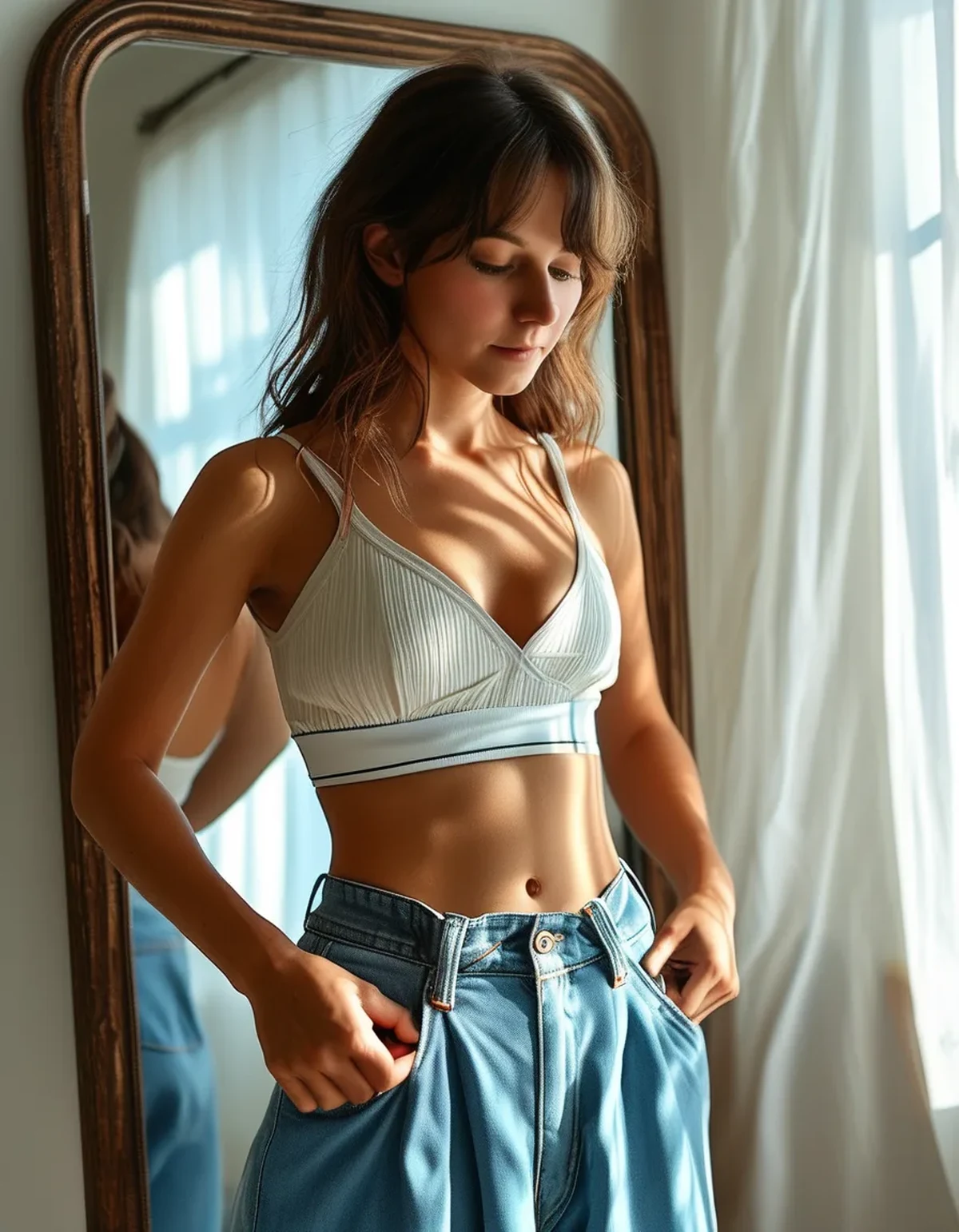
The workable version is a rise that ends at your natural waist, which on a short torso is a moderate to standard high rise rather than an extreme one. Measure where your waist actually is rather than trusting a rise measurement in centimetres.
What actually creates length?
Vertical lines, diagonal breaks, and continuity of colour. In that order.
A vertical break beats a horizontal one every time. An open cardigan, a long open shirt, a scarf hanging down, or a long necklace all create vertical lines that the eye follows top to bottom, which reads as length.
A half tuck creates a diagonal rather than a horizontal. Tucking the front only produces an angled line rather than a straight band across your middle, and an angled line does not divide the way a straight one does.
Colour continuity between top and bottom removes the division entirely. Same colour or closely related tones top and bottom means no visual break at the waist at all, which is the strongest single lengthening technique available.
A V-neck or an open collar extends the vertical line upward. On a short torso this matters more than on a long one, because you have less vertical distance to work with and every bit counts.
Third pieces should be long and open. A long open jacket or cardigan reaching mid-thigh creates two strong verticals down either side of your body. A cropped jacket adds a second horizontal line, which is the thing to avoid.
And keep hardware and detail vertical. Buttons down a front, a centre seam, or a placket all reinforce the vertical read. Horizontal pockets, chest stripes, and wide belts all fight it.
How should belts and tucking work?
Narrower, placed at your actual waist, and matched in colour where possible.
A narrow belt divides less than a wide one. Every centimetre of belt width is a centimetre of horizontal line across your shortest dimension. On a short torso, narrow is a functional choice rather than a stylistic one.
Match the belt to the trouser rather than contrasting it. A contrasting belt draws attention to exactly the line you would rather de-emphasise. A matched belt does its job without adding a division.
Find where your natural waist actually is. Bend sideways; the crease is your natural waist. Most people with short torsos are surprised by how high it sits, and most have been placing belts and waistbands below it.
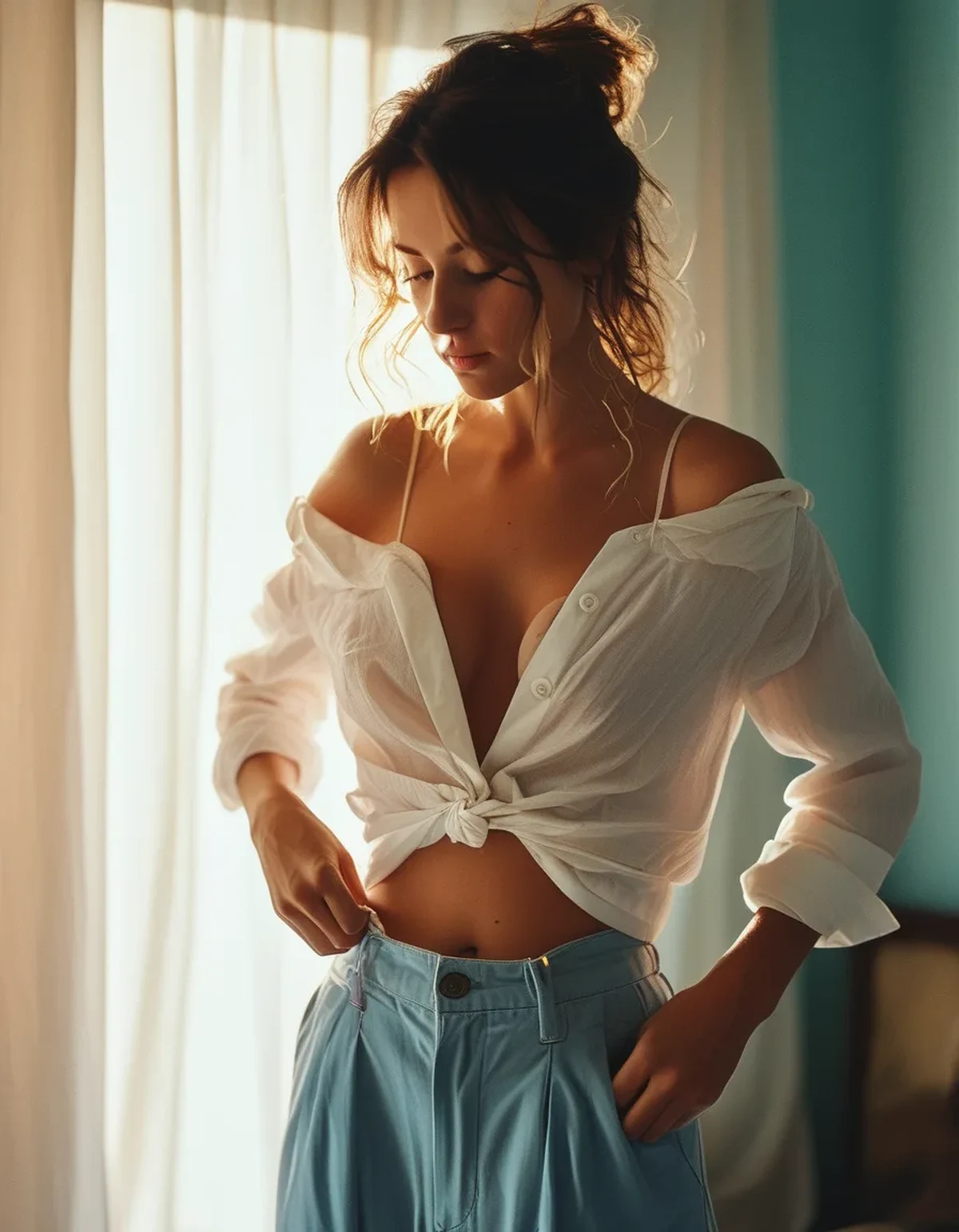
Full tuck only with a monochrome or closely-toned outfit. The full tuck is the strongest horizontal division available, so it needs the colour continuity to offset it.
Half tuck, front tuck, or a loose overhang all work better generally. They create a diagonal or a soft line rather than a hard band.
And skip the belt entirely quite often. Not every outfit needs one, and on a short torso a beltless waistline is frequently cleaner than any belt choice.
What Nobody Tells You About Torso Proportion
Most people have never measured their own proportion and are guessing. Measure from the base of your throat to your natural waist, and from your natural waist to the floor. If the first number is noticeably less than a third of your height, you have a shorter torso, and the standard advice needs adjusting rather than following.
The same garment reads completely differently on two people of the same height. This is why fitting-room disappointment after seeing something on someone else is so common, and it is proportion rather than anything else.
Petite sizing is about total height, not about torso proportion. A petite range shortens everything proportionally, which does not help if your issue is the ratio between your torso and legs rather than your overall height.
Bra fit changes torso proportion visibly. A bra that lifts properly increases the visible distance between bust and waist, which reads directly as a longer torso. This is one of the largest single-change improvements available and it costs nothing beyond a proper fitting.
Trouser rise measurements are not comparable between brands. A 30-centimetre rise in one brand sits completely differently from another depending on how the crotch curve is drafted. Trying on is the only reliable method.
And a short torso frequently comes with longer legs, which is a genuine advantage that most of this advice is oriented around exploiting rather than concealing. The goal is balance, not correction.
FAQ: Short Torso Styling Questions, Answered
Should you wear high-waisted trousers with a short torso?
A moderate high rise that ends at your natural waist works well. A very high rise that sits above your natural waist, near the ribcage, shortens the torso further and is the version to avoid.
How do you make a short torso look longer?
Vertical breaks rather than horizontal ones: open cardigans, long necklaces, V-necks, and colour continuity between top and bottom. A half tuck creates a diagonal line rather than a dividing band.
Where should a belt sit on a short torso?
At your natural waist, which is higher than most people assume. Bend sideways and the crease shows you where. Choose narrow over wide, and match the belt colour to the trousers rather than contrasting.
TL;DR:
- Very high rises sit above a short natural waist and shorten the torso further. Choose a rise that ends at your actual waist.
- Vertical and diagonal lines create length; horizontal ones divide. Half tuck rather than full tuck.
- Colour continuity between top and bottom is the single strongest lengthening technique.
- Narrow belts matched to the trousers, and quite often no belt at all.
Get properly fitted for a bra. Increasing the visible distance between bust and waist reads directly as a longer torso and costs nothing.
Keep Reading
This article is for general informational and styling purposes only. Fit, sizing, and product availability may vary.
