Why Autumn Layering Is Harder With a Short Torso and How to Fix It
Quick Answer: Layering works by stacking pieces of different lengths, and each hem creates a horizontal line. A short torso has less vertical distance between the shoulder and the natural waist, so those lines land closer together and visually compress the upper body further. The fix is fewer visible hems, longer outer layers, and moving every break point either above the natural waist or well below the hip.
The layered outfit that looks effortless on someone else looks stacked and cluttered on you, and you cannot work out which piece is the problem. It is usually not one piece — it is how many hems are visible at once.

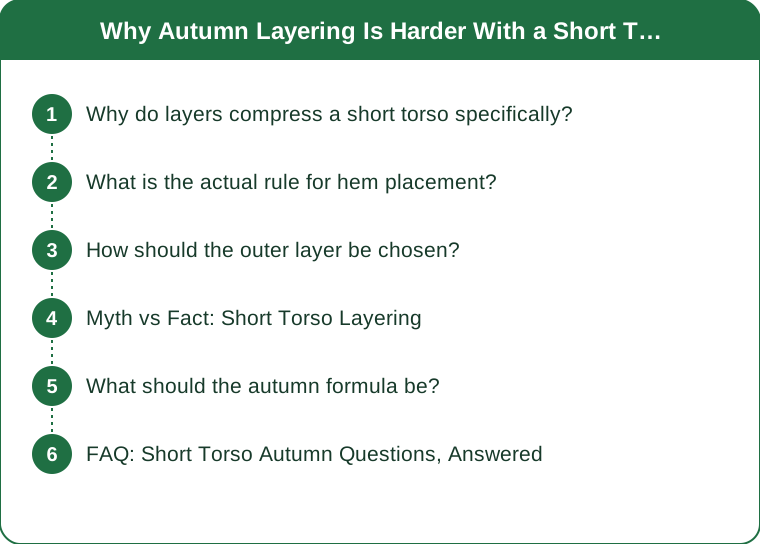
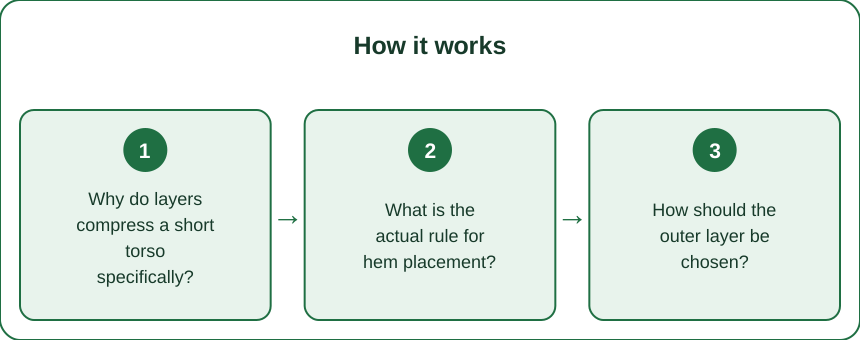
Why do layers compress a short torso specifically?
Because layering is a game of horizontal lines and you have less vertical space to distribute them across.
Every visible hem — a t-shirt under a sweater, a sweater under a jacket, a jacket over both — creates a horizontal break. Three visible hems in the space between shoulder and hip means three lines in a shorter distance.
Horizontal lines close together read as compression. Your eye registers the space between them as the length of your torso, and when those spaces are small, the torso reads as shorter than it already is.
On a long torso the same three hems have more room between them, so each space reads as substantial and the layering looks deliberate rather than stacked.
The second factor is bulk. Layers add volume, and volume in a shorter vertical space fills it more completely. The visual effect is a solid block from shoulder to hip, which removes the waist definition that creates proportion in the first place.
What is the actual rule for hem placement?
Two safe zones and one zone to avoid, and it applies to every layer.
Safe zone 1 — above the natural waist. A cropped layer that ends above your natural waist raises the perceived waistline, which lengthens the leg line. For a short torso this is the one break that helps rather than hurts, because your natural waist is already high and reinforcing it works.
Safe zone 2 — well below the hip. A layer ending at mid-thigh or longer reads as a vertical element rather than a horizontal break. Long cardigans, dusters, and longline coats work for this reason.
The zone to avoid — the hip and the low waist. A hem landing between your natural waist and your hip creates a line in the worst place: low enough to shorten the leg, high enough to sit within the torso and compress it.
The practical rule: no more than two visible hems. Base layer plus one, or one layer plus a long outer piece. Three visible hems is where it starts to look cluttered on a short torso, regardless of how good the individual pieces are.
How should the outer layer be chosen?
Longer than instinct suggests, and open rather than closed.
A long open coat or cardigan creates two strong vertical lines down the front, which is the most effective proportion tool available for a short torso. Those verticals draw the eye up and down rather than across, which directly counteracts the horizontal stacking.
Worn closed, the same coat becomes a single block and the effect is lost. If you need it closed for warmth, a belt at the natural waist restores the definition.
Cropped jackets are not off-limits, but they need to end genuinely above the natural waist rather than at it. A jacket that ends exactly at your waist creates a line at the point where you want the eye to register a narrowing, and it flattens it.
What to avoid: a mid-length jacket ending at the hip, which is the single most common autumn purchase and the least helpful length. If you own one and love it, wear it open over a longer layer so the vertical line and the longer hem do the work instead.
Myth vs Fact: Short Torso Layering
Myth: You should avoid layering entirely. Fact: You should avoid visible layering. Three layers where only two hems show works fine, and thermal base layers tucked in are invisible and add warmth without adding a line.
Myth: Tucking always helps. Fact: Tucking raises the waistline, which helps — but a full tuck with a fitted waistband can also emphasize how short the distance from waist to bust is. A front tuck or half tuck usually works better, because it creates a diagonal rather than a horizontal.
Myth: High-rise bottoms solve everything. Fact: High-rise helps the leg line and can shorten the visible torso further if the rise sits above your natural waist. Aim for a rise that hits at your natural waist, not above it — the highest-rise option is not automatically the best one for a short torso.
Myth: Belts are for defining the waist and always help. Fact: A belt at the natural waist helps considerably. A belt slung low creates a line in the avoid-zone and does the opposite. Placement matters more than the belt.
Myth: Long necklaces will fix the proportion. Fact: They genuinely help, and they are one of the cheapest tools available. A long pendant creates a vertical line and draws the eye down, which extends the perceived torso. This works better than most garment changes and costs nothing to try with what you already own.
What should the autumn formula be?
A specific structure that handles the temperature swing without stacking.
- Base: a fitted top, tucked or front-tucked. Invisible warmth can go under this — a thin thermal layer adds no visible hem
- Middle: one layer, either cropped above the natural waist or long enough to pass the hip. Not hip length
- Outer: a long coat or cardigan, worn open, providing the vertical lines
- A long necklace or a scarf worn hanging rather than wrapped, both of which add vertical
- High-rise bottoms hitting at the natural waist, not above it
Total visible hems: two. Base and outer, with the middle layer either tucked or long enough to be part of the vertical rather than a break.
On scarves specifically: a scarf is the most common autumn accessory and the one that most often goes wrong here. Bulk around the neck fills the shortest part of your vertical space, so a chunky wrapped scarf compresses more than almost anything else. A long thin scarf hanging straight down does the opposite and adds a strong vertical line.
And the piece worth buying if you buy one thing this season: a long open cardigan or duster in a neutral. It is the single most useful garment for this proportion and it works over almost everything else you own.
FAQ: Short Torso Autumn Questions, Answered
Can I wear a chunky knit sweater at all?
Yes, with two adjustments: choose one long enough to pass the hip rather than ending at it, and wear it with a high-rise bottom so the waistline stays defined by the trouser rather than by the sweater hem. A cropped chunky knit also works if it genuinely ends above the natural waist.
What about a puffer jacket?
Length is everything. A cropped puffer ending above the natural waist works well. A hip-length puffer is the hardest garment on this list, because it combines the worst hem position with maximum bulk. Longline puffers reaching mid-thigh work far better than the standard length.
Does a monochrome outfit really help?
Substantially, and it is the easiest fix available. Keeping the layers in one color family removes the color contrast at each hem, so the horizontal lines become far less visible even though the hems are still there. A single-color layered outfit can carry three layers where a multicolored one cannot carry two.
TL;DR:
- Every visible hem is a horizontal line, and a short torso has less vertical space to distribute them
- Keep visible hems to two, and place them above the natural waist or well below the hip — never at the hip
- A long open coat or cardigan creates vertical lines that counteract the horizontal stacking
- Long necklaces, hanging scarves, and monochrome layering all help more than any single garment change
Autumn layering is not harder because of your proportions. It is harder because the standard layering advice assumes vertical space you have less of, and adjusting where the lines land solves nearly all of it.
Keep Reading
This article is for general informational and styling purposes only. Fit, sizing, and product availability may vary.