Why Sleeve Length Changes Torso Proportion More Than You Expect
Quick Answer: Your eye reads horizontal lines across the body as division points, and a sleeve hem is one of the strongest. Where the sleeve ends creates a visual marker at that height, which the eye uses to judge where your torso ends and your legs begin. A sleeve ending at the high hip emphasizes the waist-to-hip region and visually shortens the torso; a sleeve ending at the wrist or pushed to mid-forearm removes that marker entirely.
It is the easiest proportion adjustment available and requires buying nothing.
Why does a sleeve hem read as a body line?
Because the eye groups things at the same height, whether or not they are connected.
When you look at a figure, you are not reading each element separately. Your visual system finds alignments and treats things at the same level as a single horizontal band. A sleeve hem, a hemline, a belt, and a bag strap that all end near the same height combine into one strong line.
That line becomes a division point. Everything above reads as one section and everything below as another, and the eye uses those sections to judge proportion.
Sleeve hems are unusually strong markers for two reasons. They appear twice, symmetrically, which the eye reads as intentional. And there is usually a contrast at that point — sleeve fabric ending against bare arm, or against a different texture.
The reason this matters for torso proportion specifically: most sleeve hems fall in the region between the waist and the mid-hip, which is exactly the region that determines whether a torso reads as long or short.
A three-quarter sleeve typically ends around the high hip. A short sleeve ends near the natural waist. A full-length sleeve ends at the wrist, well below the hip and outside the zone where the eye is judging torso length.
So the sleeve you choose is placing a line inside the most consequential region of your silhouette, usually without any intention on your part.
Which sleeve lengths do what?
Four positions, each with a predictable effect.
Full length, at the wrist. The line falls below the hip, outside the torso-judging zone. This is the most neutral option and generally the safest for anyone wanting to avoid shortening the torso.
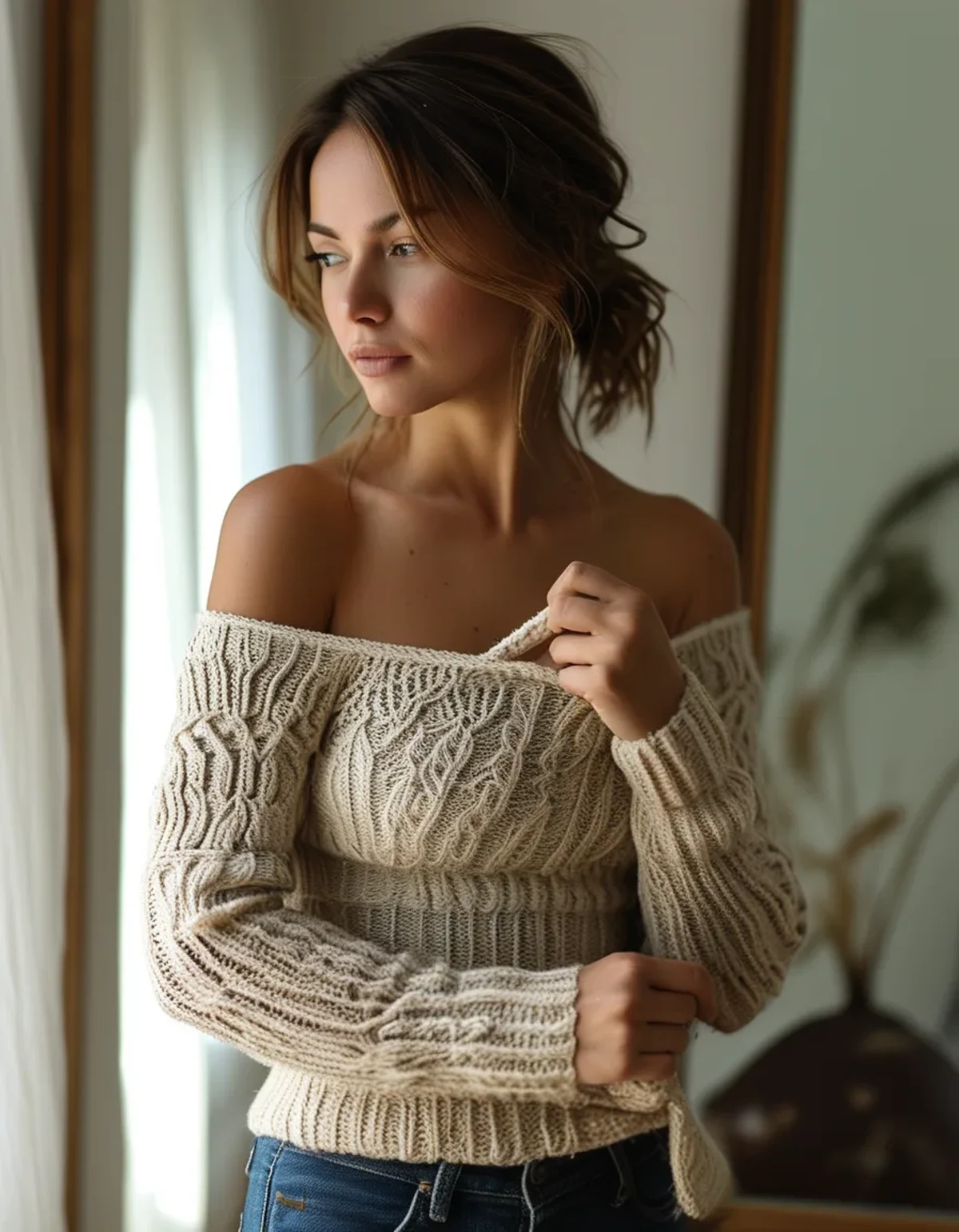
Pushed to mid-forearm. The most flattering position for many people, and the reason it looks casually good on everyone. It places the line at the natural waist or just above, which emphasizes the narrowest point and creates an impression of a defined waist rather than a division. It also exposes the wrist, which is a slim point and reads as delicate.
Three-quarter, ending at the high hip. The most problematic for a short torso. It marks the widest part of the hip region and creates a strong horizontal exactly where you would rather not have one. On a long torso, the same sleeve is often fine or even useful.
Short sleeve, at the mid to upper arm. The line is high, above the waist entirely. Neutral for torso length, and it does affect how wide the upper body reads — a sleeve ending at the widest part of the upper arm draws attention there.
The practical takeaway: push your sleeves up. It is free, it takes two seconds, and for most people it is the single most flattering sleeve position. There is a reason it looks deliberate on other people; it is deliberate.

What Nobody Tells You About Sleeve Lines
Alignment stacking is the real problem. One horizontal at the hip is manageable. A sleeve hem, a top hem, and a bag all landing there is a heavy line that dominates the whole outfit. Check that your horizontals are not stacking, and if they are, move one.
Contrast intensity matters as much as position. A dark sleeve ending against bare skin is a much stronger line than a sleeve ending against a similarly-toned layer. If a sleeve has to end at an awkward height, reducing the contrast at that point softens it considerably.
Cuff volume amplifies everything. A wide or gathered cuff draws more attention to the line than a plain one. Voluminous sleeve trends are lovely and place a very strong marker wherever they end.
Sleeves and jacket length interact. A jacket sleeve slightly longer or shorter than the layer beneath creates two lines close together, which reads as a band rather than a line. Sometimes that is elegant and often it is just busy.
Pushed sleeves stay pushed on some fabrics and not others. Ribbed knits and structured cotton hold; smooth jersey and silk slide back down within minutes. If you rely on the pushed-sleeve position, fabric choice is not incidental.
The effect is stronger in photos than in the mirror. Photographs flatten depth, which makes horizontal alignments more prominent. If an outfit looks fine in the mirror and wrong in pictures, stacked horizontals are one of the usual causes.
How do you use this practically?
Four adjustments, all free.
Push your sleeves to mid-forearm as a default. For knits, shirts, and jackets alike. If a piece resists it, a single fold at the cuff gets you most of the way.
Audit where your horizontals land when you get dressed. Look in the mirror and identify the lines: sleeve hems, top hem, waistband, bag strap. If three of them are within a couple of inches of each other, move one. Usually the easiest to move is the sleeve.
Avoid three-quarter sleeves ending at the high hip if you have a short torso. Or push them up, which converts them into a mid-forearm sleeve and solves it entirely.
Match sleeve contrast to what you want emphasized. Low contrast at the sleeve hem when you want the eye elsewhere; high contrast when you actively want a defined waist marker.
One seasonal complication worth planning for. Autumn layering multiplies the number of sleeve hems in play. A base layer, a knit, and a jacket produce three sleeve lines, and if they land at three different heights the effect is cluttered rather than layered.
The fix used by people who layer well: stagger deliberately or align deliberately, but do not let it happen randomly. Either push everything to the same mid-forearm position, or let each layer end at a clearly different height — a base layer at the wrist, a knit pushed up, a jacket at the wrist. Two heights read as intentional; three heights an inch apart read as an accident.
As you build autumn outfits over the next few weeks, this is worth checking once in a mirror per combination. After that it becomes automatic.
FAQ: Sleeve Length Questions, Answered
What is the most universally flattering sleeve length?
Pushed to mid-forearm, for most people and most contexts. It marks the waist rather than the hip and exposes the wrist. Full-length at the wrist is the safest formal alternative.
Are three-quarter sleeves always bad?
Not at all — they are unhelpful specifically when they end at the high hip on a short torso. On a longer torso, or when they end above the hip, they work well. As with most styling rules, it is about where the line lands on you rather than the category.
Does this apply to outerwear too?
Yes, and often more strongly, because coats and jackets are usually higher contrast against what is underneath. A cropped jacket ending at the high hip is the same problem in a heavier form.
How do I keep pushed sleeves from falling down?
Choose fabrics with structure or texture — ribbed knits, heavier cotton, anything with a bit of grip. Or fold the cuff back once rather than bunching, which holds far better on smooth fabrics.
TL;DR:
- The eye groups things at the same height into a single horizontal band, and sleeve hems are strong markers because they appear symmetrically with contrast.
- Most sleeve hems land between the waist and mid-hip, which is exactly the region that decides whether a torso reads long or short.
- Mid-forearm is the most flattering position for most people; three-quarter ending at the high hip is the least, on a short torso.
- Watch for stacked horizontals — sleeve, hem, and bag strap all landing together — and move one of them.
Push your sleeves up before you next look in the mirror. It is the cheapest proportion change you will ever make.
Keep Reading
This article is for general informational and styling purposes only. Fit, sizing, and product availability may vary.
