The Same Scarf Can Shorten or Lengthen Your Torso
Quick Answer: A scarf creates a strong vertical or horizontal line depending on how it hangs. Long loose ends running down the front read as vertical and lengthen the torso. Bulk gathered at the neck or a scarf ending at mid-chest creates a horizontal break high on the body and shortens it. For a short torso, the rule is length down, bulk minimized.
You put on the scarf and something looked off. You took it off and the outfit was fine.
The scarf was not wrong. It was tied in the one way that cuts your torso exactly where you did not want it cut.
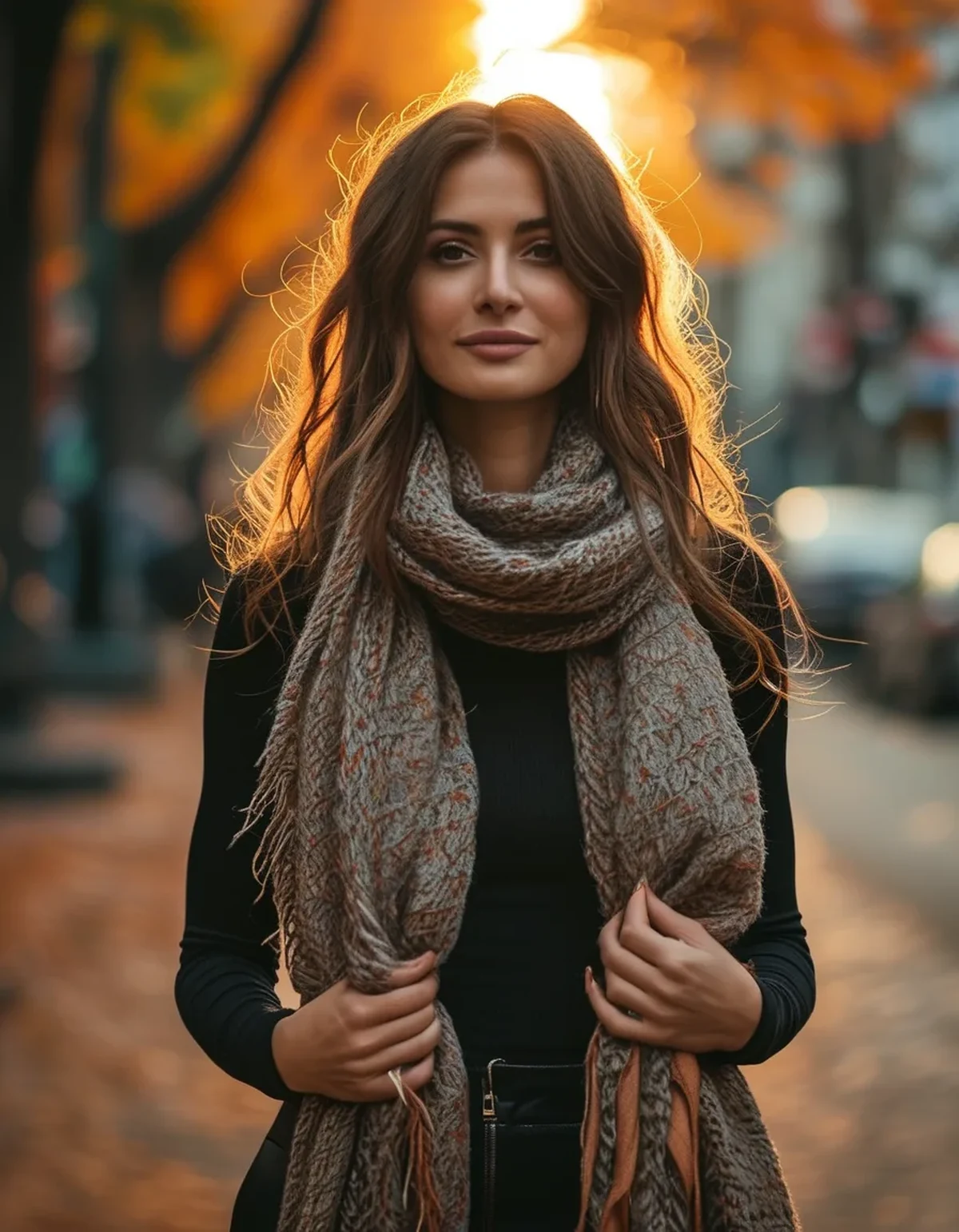
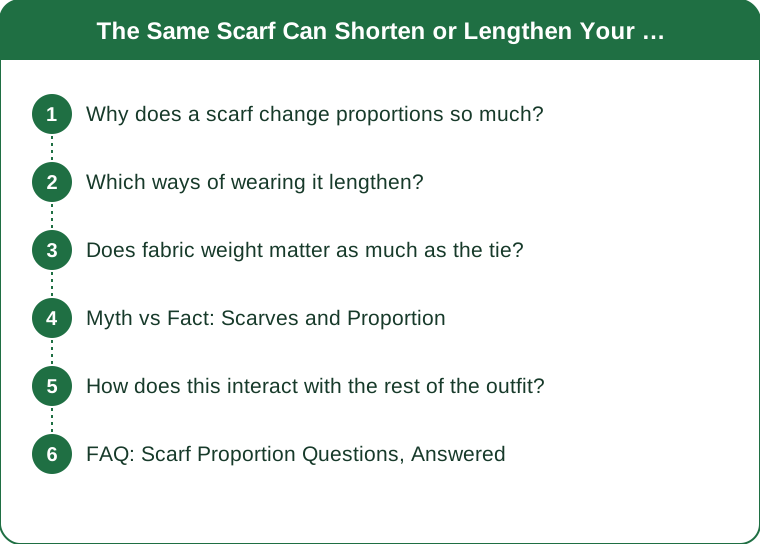
Why does a scarf change proportions so much?
Because the eye reads a vertical line as length and a horizontal line as a division.
Your torso appears to run from wherever the eye perceives it starting — usually a neckline or a strong horizontal — to wherever it perceives it ending, usually a waistband or hem. Anything that creates a strong horizontal in between splits that run into two shorter segments.
A scarf is unusually powerful at this because it sits at the top of the torso, often in a contrasting color and texture, exactly where the eye starts reading. A bulky wrap at the neck effectively moves the start of your torso downward by several inches, which is the entire visible length of a short torso disappearing into a knot.
Conversely, two long ends hanging down the front create an uninterrupted vertical that the eye follows all the way to where they stop. That reads as continuous length, which is why the same scarf worn loose looks entirely different from the same scarf looped twice.
Which ways of wearing it lengthen?
Ranked by how much vertical they create:
Best: draped straight down, both ends hanging. Two parallel verticals running the full length of the torso. The most lengthening option available, and the simplest.
Very good: single loop with long tails. One pass around the neck with both ends left long. Slight bulk at the neck, strong vertical below it.
Good: tucked into a coat or jacket with ends visible below the chest. The vertical continues under the outer layer and the eye follows it.
Neutral: a long thin scarf tied loosely with a low knot at chest level. The knot creates a mild horizontal but the tails below compensate.
Shortening: double or triple loop at the neck. Maximum bulk, maximum horizontal, zero vertical.
Most shortening: a wide blanket scarf wrapped high and full. Beautiful on a long torso, and it removes several inches of visible torso from a short one.
The pattern is straightforward once you see it — every arrangement is a tradeoff between warmth at the neck and vertical line down the front.
Does fabric weight matter as much as the tie?
Nearly as much, because bulk is the other half of the equation.
A fine silk or modal scarf can be looped twice and still produce a slim result. A chunky wool or blanket scarf produces significant volume from a single loop, and volume at the neck reads as a horizontal regardless of how you arranged it.
Rough guidance:
- Silk, modal, fine cotton: any tie works. Bulk is never the limiting factor.
- Fine merino, cashmere: single loop with long tails is the sweet spot.
- Chunky wool, blanket weight: draped straight down only, or accept the shortening effect as a deliberate choice.
Color plays into this too. A scarf that contrasts strongly with the top underneath creates a sharper horizontal than one that blends. So a cream scarf on a cream sweater can be worn more freely than a black scarf on a cream sweater, which draws a hard line exactly where it sits.
If you love a big scarf and have a short torso, the workable compromise is a chunky scarf in a color close to your top, worn draped rather than wrapped.
Myth vs Fact: Scarves and Proportion
Myth: Short torsos should avoid scarves. Fact: draped long, a scarf is one of the more lengthening accessories available. It is the wrapping that causes trouble, not the scarf.
Myth: Longer scarves are always better for length. Fact: only if worn long. An extra-long scarf that gets looped three times to manage the excess produces more bulk than a shorter one worn draped.
Myth: The effect only matters with a coat off. Fact: it often matters more with a coat on, because the coat’s opening already creates a vertical and the scarf either continues it or blocks it at the top.
Myth: Thin scarves do not have enough presence to matter. Fact: a thin scarf in a contrasting color creates a strong visual line despite low volume. Contrast does as much work as bulk.
How does this interact with the rest of the outfit?
The scarf is one line among several, and it works best when it agrees with the others.
With a high neckline: the torso already starts high, so a scarf with long tails extends the existing vertical nicely. This is the easiest combination.
With a V-neck or open collar: the neckline is already creating a vertical. A draped scarf reinforces it. A wrapped scarf covers it and wastes the effect the neckline was providing.
With a belted waist: the belt is a horizontal at the bottom of the torso. A scarf ending well above it leaves an awkward short segment between. Either take the scarf tails past the belt line or keep the scarf very close to the neck.
With a cropped jacket: the jacket hem is already a horizontal high on the body. Adding neck bulk on top of that creates two horizontals in a small space, which is the most shortening combination in this article.
With an open long coat: the best case. Two verticals from the coat, two from the scarf, all running the same direction. This is why the long-coat-and-draped-scarf combination looks so reliably good on everyone.
FAQ: Scarf Proportion Questions, Answered
How long should a scarf be for a short torso?
Long enough that draped straight down, the ends fall at or below your hip. That gives you the full vertical without needing to loop to manage excess. Roughly 70-80 inches works for most people, though it depends on height as much as torso length.
What about scarves worn as a neck accessory, like a silk square?
A small silk square tied close at the neck is a horizontal, but a very small one — it does not add bulk and it sits above the collarbone rather than on the chest. In practice it reads more as jewelry than as a proportion element, and it is one of the safer options if you like something at the neck.
Does this apply to hoods and collars too?
Yes, and it explains a lot of the frustration with certain coats. A large hood or a wide shawl collar creates the same bulk-at-the-neck effect as a wrapped scarf. If big scarves have never worked for you, oversized hoods and wide collars probably do not either, and the reason is identical.
TL;DR:
- The eye reads vertical as length and horizontal as division; a scarf sits exactly where your torso starts.
- Draped straight down with long ends is the most lengthening; double and triple loops are the most shortening.
- Fabric weight and color contrast matter nearly as much as the tie — bulk and contrast both create horizontals.
- A cropped jacket plus a wrapped scarf is the most shortening combination available.
- Long open coat plus draped scarf is the most flattering, because every line runs the same way.
The experiment worth doing in front of a mirror once: take one scarf and try it draped, single-looped, and double-looped, in that order. The difference between the first and the last is larger than most people expect from a single accessory, and once you have seen it on your own body you will never have to think about it again.
Keep Reading
This article is for general informational and styling purposes only. Fit, sizing, and product availability may vary.
